Roof math breaks down when someone mixes surface area, horizontal run, and unit conventions in the same
conversation. The fastest way to reduce expensive mistakes is to use the right calculator for the right
question and keep your inputs in the units the tool expects.
By Construction Pro TeamLast updated March 29, 2026
App Screenshot
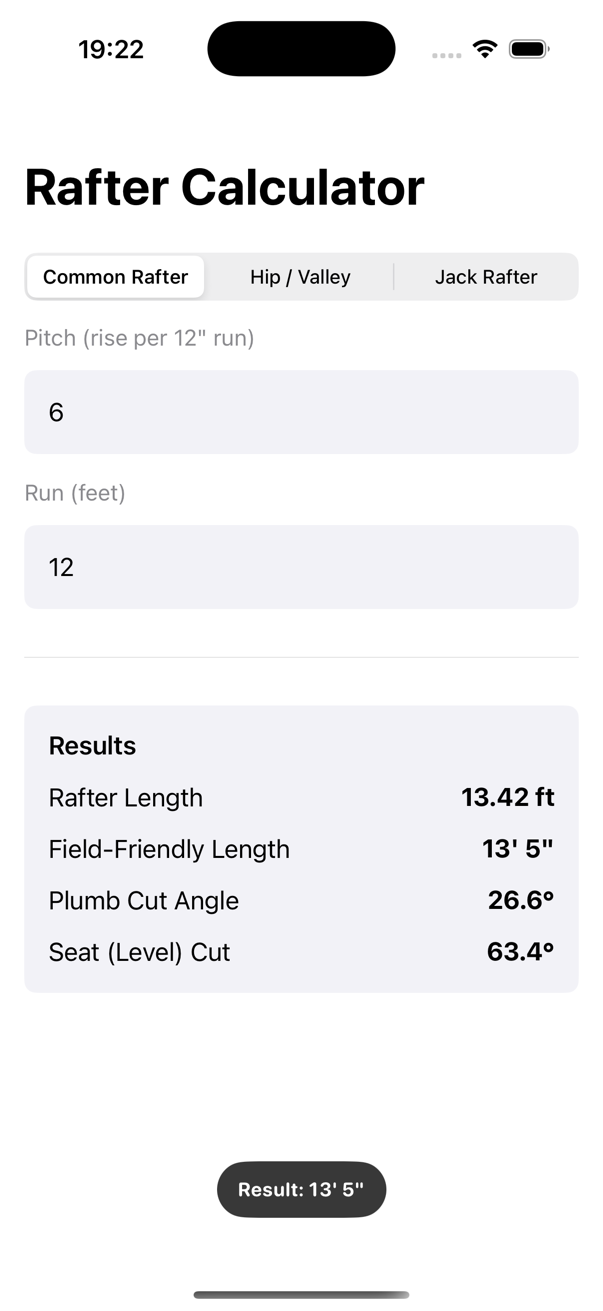
Roof-math mistake check screen
This screenshot comes from the half-span roof-framing recording that supports this article.
Recorded framing workflow used to show why common-rafter run should use half-span instead of full width.
Quick answer
24 ft building width at 6:12 pitch: the common-rafter run is 12 ft, not 24 ft.
1,200 sq ft plan area at 6:12 pitch: actual roof area is about 1,341.6 sq ft, and with 10% waste the order is about 14.76 squares.
16 in overhang entered as 16 ft: the takeoff explodes immediately because the unit is wrong.
Field Use
Why these three mistakes cost so much
Roof work tends to combine estimating, framing, and ordering under time pressure. A small input
mistake can double a run, underbuy shingles, or create a nonsense takeoff before anyone notices.
Use this checklist before framing numbers go to the saw.
Use it before roofing orders are sent to a supplier.
Use it when switching between rafter math and roof area math on the same project.
Worked Examples
Three expensive mix-ups to avoid
Each example below maps to a common error pattern that the app helps prevent when the right tool is used.
Example 1
Using full building width instead of half-span
Inputs: 24 ft building width and 6:12 pitch.
For a centered gable, the common-rafter run is 12 ft, not the full building
width. If you enter 12 feet into the Rafter Calculator, the correct length is about
13.42 ft. Doubling the run would produce a rafter that makes no framing sense.
Example 2
Forgetting slope when ordering shingles
Inputs: 1,200 sq ft plan area and 6:12 pitch.
A plan area of 1,200 sq ft is not the roof area on a sloped roof. The Roof Estimator shows the
real roof area at about 1,341.6 sq ft. Add 10% waste and the
order climbs to about 14.76 squares, not 12 squares.
Example 3
Mixing inches and feet on overhang input
Inputs: 16 in overhang entered as 16 ft by mistake.
The Roof Estimator expects overhang in inches. Entering 16 as feet would make
the effective roof size absurd and inflate the square count instantly. This is one of the
easiest bad entries to catch if the unit label is checked before running the takeoff.
What throws people off
Pattern behind the bad numbers
Using one roof term when the job actually needs another, like run versus roof area.
Switching tools but keeping the old assumption in your head.
Moving too fast past the unit labels on entry fields.