Quick answer
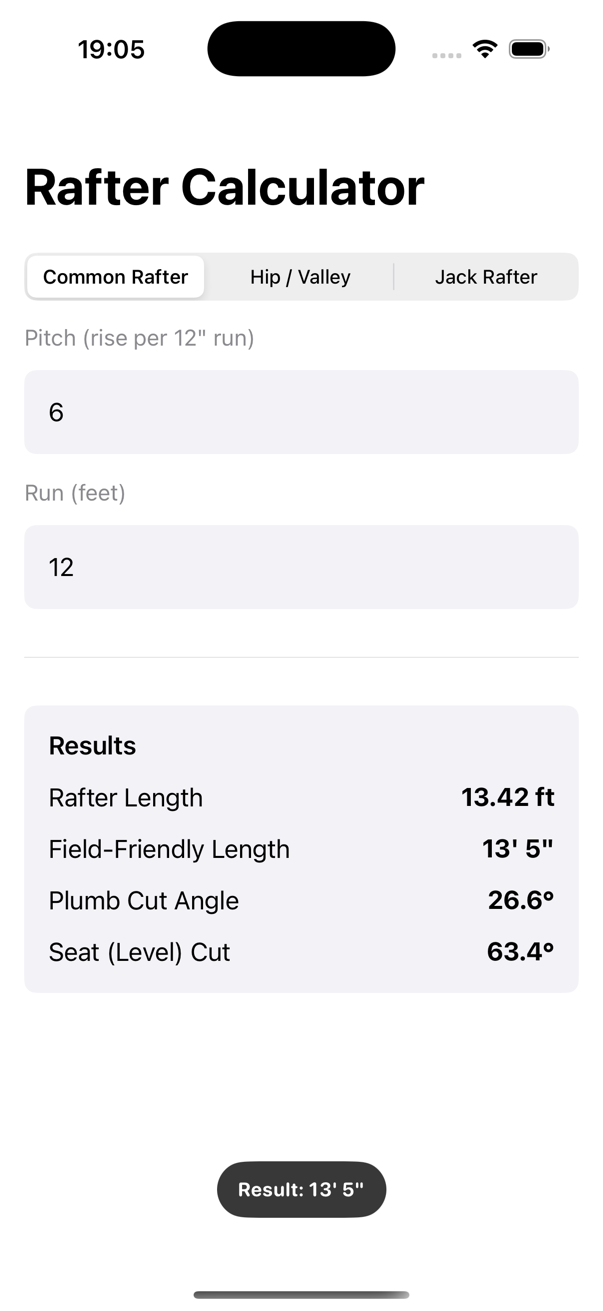
- 6:12 pitch + 12 ft run: about 13.42 ft, or roughly 13'-5".
- 4:12 pitch + 10 ft run: about 10.54 ft, or roughly 10'-6 1/2".
- 8:12 pitch + 8 ft run: about 9.61 ft, or roughly 9'-7 5/16".
To calculate common rafter length, start with the horizontal run, apply the roof pitch as rise per 12, and convert the result into a field-friendly feet-inch-fraction measurement for layout or a cut list. In Construction Pro, the Rafter Calculator handles both the decimal length and the tape-ready display.
This screenshot comes from the garage gable roof framing recording used for this support topic.
This calculation shows up any time a builder needs a reliable common-rafter baseline before final cut adjustments. Garage roofs, porch roofs, and shed additions all depend on a clean run value and the right pitch entry.
These examples match the app's current common-rafter workflow and show how decimal output turns into a practical tape measure value.
Example 1
Inputs: 6:12 pitch and 12 ft run.
Enter a pitch of 6 and a run of 12 in the Rafter Calculator. Construction Pro returns a common rafter length of about 13.42 ft, which is roughly 13'-5" for a field-friendly cut list. This is the number to start from before adding or trimming for overhang details and final seat layout.
Example 2
Inputs: 4:12 pitch and 10 ft run.
A shallower shed roof still needs the same process: use the true run, not the roof surface length. The app returns about 10.54 ft, which is about 10'-6 1/2". That conversion is what makes the result immediately useful at the saw or on a handwritten framing list.
Example 3
Inputs: 8:12 pitch and 8 ft run.
Steeper roofs magnify small entry mistakes, so this is where the angle and length outputs help most. Construction Pro calculates about 9.61 ft, or 9'-7 5/16", before final seat and plumb cut layout. It is a good example of why feet-inch-fraction output is easier to trust on site than decimal feet alone.
Common mistakes
Related guides
Usually yes. For a centered ridge gable roof, the common-rafter run is the half-span, not the full building width.
No. The common-rafter tool uses the run you enter. Add overhang only if that is how you want to model the rafter.
Because the crew usually lays out and cuts from a tape, not from a decimal-foot display.
Construction Pro keeps the common-rafter result, field-friendly conversion, and cut-angle checks together in one screen.