How to Calculate Stair Rise, tread count, and total run.
A practical stair layout starts with total rise, then backs into riser count, tread count, total run,
and stringer length. Construction Pro's Stair Calculator handles that sequence and also flags common
code-check issues when the riser or tread assumptions drift outside typical limits.
By Construction Pro TeamLast updated March 29, 2026
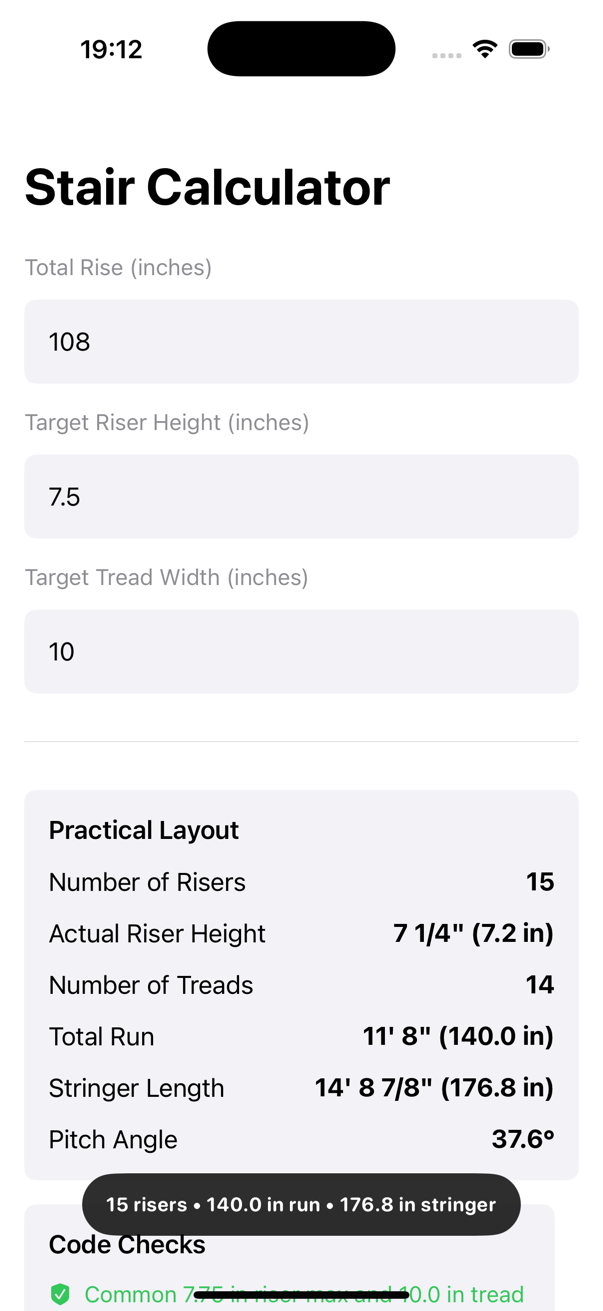
App Screenshot
Stair layout screen
This screenshot comes from the main interior stair layout recording for the Stair Calculator.
Recorded Stair Calculator screen showing rise, tread count, total run, and stringer output.
Quick answer
108 in rise, 7.5 in target riser, 10 in tread: 15 risers, 14 treads, 140 in total run, about 176.8 in stringer length.
120 in rise, 7.5 in target riser, 10 in tread: 16 risers, 15 treads, 150 in total run, about 192.1 in stringer length.
42 in rise, 7 in riser, 11 in tread: 6 risers, 5 treads, 55 in total run, about 69.2 in stringer length.
Field Use
Where this stair math earns its keep
Builders use this calculation for interior stairs, basement stairs, deck stairs, and remodel
work where space gets tight. It is especially helpful when you need to reconcile a target riser
with the actual rise available between finished levels.
Use it before cutting stringers or framing a stair opening.
Use it to explain layout changes to a client or project manager.
Use it to see whether a target tread and riser pair still passes common code checks.
Worked Examples
Three stair layouts
The examples below reflect the exact sequence used by the Stair Calculator in Construction Pro.
Example 1
Main interior stair layout
Inputs: 108 in total rise, 7.5 in target riser, 10 in tread.
Construction Pro rounds this setup to 15 risers, which means the actual riser
height lands around 7.2 in. That produces 14 treads,
140 in of total run, and about 176.8 in of stringer length.
Example 2
Basement stair framing
Inputs: 120 in total rise, 7.5 in target riser, 10 in tread.
A taller floor-to-floor height pushes this one to 16 risers and
15 treads. The total run becomes 150 in, and the stringer
length works out to about 192.1 in. It is a good check before committing to a
long straight stair run in a basement.
Example 3
Backyard deck stair
Inputs: 42 in total rise, 7 in riser, 11 in tread.
For an exterior stair with deeper treads, the result is 6 risers,
5 treads, 55 in of total run, and about
69.2 in of stringer length. That makes it easy to compare the stair footprint
with the available deck landing space.
Common mistakes
What trips up stair layout
Confusing riser count with tread count. Straight stairs usually have one fewer tread than risers.
Expecting the actual riser to stay exactly on the target number after rounding.
Skipping code-check review before cutting stringers.